Dražen Bulatović, Director and Owner of Ravel Podgorica
From succeeding his father in a family business to leading one of Montenegro’s longest-standing infrastructure companies, Dražen Bulatović reflects on growth, trust, and long-term responsibility
When a hospital loses its electricity or water supply, everything else – even the most expensive equipment and the most beautiful façade – instantly becomes irrelevant. There is a layer we do not see, yet on which literally everything that has been built rests: cables, pipes, distribution systems and installations. The world took it for granted for a long time, but today it must invest unimaginable sums in it. According to estimates, by 2040 the world will face a shortfall of around USD 15 trillion simply to ensure that infrastructure keeps pace with growth. In the coming years, Montenegro is preparing to invest around EUR 9 billion in roads and energy infrastructure.
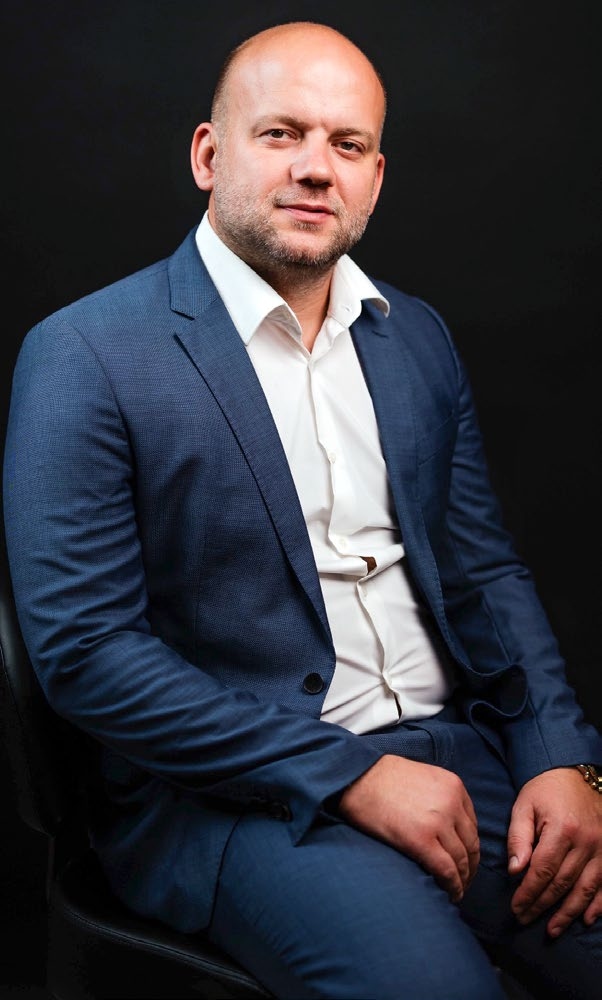
Dražen Bulatović leads Ravel, one of the few Montenegrin family businesses more than three decades old, which operates at this fundamental level and, along the way, has survived what almost no family business in Montenegro survives: the transition from one generation to the next. We spoke about why his work has become the work of the future, what happens when it is not taken seriously, and why there can be no growth without planning and the highest standards of quality.
Your industry is rarely in the spotlight. Why do you consider it, in fact, one of the most important?
Because everything else depends on it, imagine the most modern hospital, airport, or factory – all of it is worth exactly as much as the extent to which its electricity, water, and heating systems can function. The moment that layer fails, nothing else matters: even the most expensive equipment or technology becomes worthless. That is what we do. I like to say that we are the bloodstream and nervous system of every building. This is critical infrastructure. That’s why, in this business, quality is non-negotiable. A cheap solution at the foundation always comes at a high price later- through a breakdown, downtime, or, in the worst-case scenario, a fire. What cannot be seen must work flawlessly, because everything that can be seen is built upon it. This is true not only in my line of work, but in everything.
“WE ARE THE BLOODSTREAM AND NERVOUS SYSTEM OF EVERY BUILDING. THIS IS CRITICAL INFRASTRUCTURE, AND THAT IS WHY I TAKE MY WORK VERY SERIOUSLY.”
So where is this market heading – in Montenegro, across the region and globally?
It is moving forward, and at an accelerating pace. The International Energy Agency is already describing this period as the “Age of Electricity”: global electricity consumption is growing by more than three and a half per cent annually, two and a half times faster than all other forms of energy, and by 2030 alone, the world will add electricity demand equivalent to more than twice the current consumption of the European Union. Artificial intelligence, data centers, electric vehicles, cooling – all of these are driving demand in the same direction, and ultimately all of it runs through cables and pipes. To keep pace with all of that, investment in networks will need to increase by half. In Montenegro, this is not an abstract issue. The country will be investing heavily in transport and infrastructure in the coming years, with plans for nearly 500 kilometers of motorways and expressways, while electricity generation is growing strongly. But here is the key point, and this is what I want people to remember: there is no economic growth without infrastructure, and there is no serious infrastructure without two things – planning and the highest standards of quality. Money invested in infrastructure without planning and without the highest standards of quality is not an investment; it is literally money buried in the ground. That is why this industry lies at the very foundations of every country’s development.
“THE REISNO ECONOMIC GROWTH WITHOUT INFRASTRUCTURE, AND THERE IS NO INFRASTRUCTURE WITHOUT PLANNING AND THE HIGHEST STANDARDS OF QUALITY. MONEY INVESTED WITHOUT A PLAN IS NOT AN INVESTMENT; IT IS LITERALLY MONEY BURIED IN THE GROUND.”
Your company has been in business for three decades. Just how rare is that in our region?
Rarer than people think. In some countries, family businesses have existed for centuries and have the experience and support that we are only beginning to build here. In Germany, companies are a hundred years old or more, with the fifth generation at the helm. Here, that is almost non-existent because private enterprise is still relatively new, dating back only a few decades. A company that has lasted for thirty years here has literally survived everything: the transition, crises, and the internal ups and downs that accompany growth. That represents thirty years of continuous work, promises kept, and trust built one client at a time. I am deeply aware that I did not start from scratch, but from the foundations my father spent years building. That is precisely why I feel responsible for building on everything he created and developed.
“A COMPANY THAT HAS LASTED FOR THIRTY YEARS HERE HAS LITERALLY SURVIVED EVERYTHING. THAT REPRESENTS THIRTY YEARS OF PROMISES KEPT.”
You took over the company from your father. Statistics show that only around one in ten family businesses survives the transition to the second generation. How did you navigate that transition?
Those statistics are harsh, and many family businesses close down or are sold during the transition from one generation to the next. The reason is usually not money, but people: the founder doesn’t know how to let go, while the successor doesn’t know how to take over, or takes over only to preserve what is already there exactly as they found it. My father gave me something of the greatest value: his trust and the freedom to do things my own way. I quickly realized that I had inherited the company and, with it, the responsibility to develop it. I respect everything he built before me, but my responsibility is not to be the custodian of what I inherited; it is to take the company where, in his time, he had neither the tools nor the market to take it. To me, that is the only way to repay my father for his work truly.
“I INHERITED THE COMPANY, BUT WITH IT ALSO THE RESPONSIBILITY TO GROW IT. A LEGACY IS PRESERVED BY DEVELOPING IT AND BUILDING UPON IT.”
In the ten years since you took over, the company has grown, while you have completed a master’s degree and become a father of three – all before the age of forty. How do you look back on those ten years?
As one long training session. The company and I have grown side by side. You cannot take a company further than you have progressed yourself. When I took over the business, the company had only a handful of employees; today, it has grown into a business with highly qualified professionals, partners, projects, and standards. I don’t want this to sound like boasting, because it isn’t. It is something you work at every single day, both at work and at home. I am a runner myself, and running has taught me a lesson that applies equally to business: results don’t come from one big step, but from a thousand small ones you keep taking even when you don’t feel like it. Growth is a decision you make every morning, not an event that happens to you.
“YOU CANNOT TAKE A COMPANY FURTHER THAN YOU HAVE PROGRESSED YOURSELF. GROWTH IS A DECISION YOU MAKE EVERY MORNING, NOT AN EVENT THAT SIMPLY HAPPENS TO YOU.”
What has been the hardest lesson along the way?
That the fastest route is not “I’ll do everything myself”. An ambitious person instinctively thinks: if I want something done properly, I have to do it myself. And that takes you a long way at first, but eventually it is precisely what holds you back. A company grows beyond what one person can keep in their head, and that is where things start to break down. Either you learn to lead people, or you remain trapped in your own company as its most expensive employee. I am still learning that myself. The hardest thing for me was accepting that my job is no longer to do everything myself, but to support people and create a system that works well even when I am not in the room. Hard work will take you only so far; beyond that point, excellence and the trust you have earned take you further.
“EITHER YOU LEARN TO LEAD P EO P LE, O R YO U R EM A IN TRAPPED IN YOUR OWN COMPANY AS ITS MOST EXPENSIVE EMPLOYEE.”
You are the father of three young children. How do you combine that with running a growing company?
Honestly? It is difficult, just as it is for everyone. I would not pretend to have a formula. But over time, I have changed my definition of success. There was a time when success, for me, meant only the company’s growth. Today, success means running a serious business while having the freedom to be a present father and husband. Not perfect, but present. That freedom is the real goal. And, paradoxically, this is exactly what makes me better at my job, because when you know why you are working, you work more calmly and more intelligently.
“TODAY, SUCCESS MEANS RUNNING A SERIOUS BUSINESS WHILE HAVING THE FREEDOM TO BE A PRESENT FATHER AND HUSBAND AT THE SAME TIME.”
Where does Ravel go from here – what is the next step?
We are developing in three directions. The first is projects – refurbishment, reconstruction, and construction. Nothing gives me greater satisfaction than knowing that our work stands behind facilities Montenegro can be proud of, such as kindergartens, healthcare institutions, and major infrastructure projects. There is no room for improvisation here: we work in accordance with ISO quality standards and based on verifiable references, because in this business it takes years to build a reputation and just one bad job to lose it. The highest standards of quality are the only way to ensure that what we install lasts for decades.
The second direction is people and, frankly, that is where the next stage of our growth lies. The company has reached the point where further growth no longer depends on how much I can do, but on the quality of the people I bring together. That is why we are currently building our team and looking for someone to take charge of operational management, someone who will work alongside me to keep the most important things firmly on track: the team, tenders, and contracts. I will take this opportunity to say it publicly as well: if you are an ambitious and highly capable professional with the right profile and want to build something that lasts, get in touch with us.
And the third direction is the most exciting of all: bringing the knowledge we have been applying to large systems for years down to the level of every home. The same care and standard that a hospital or factory requires should also be available to households and small businesses – because their electricity, water and heating systems also need to function flawlessly. What large systems have had for a long time, but ordinary people have not, is a single reliable partner to handle all breakdowns and regular maintenance, instead of having to panic when something stops working. We are developing services that, with digitalization, will make this simple and accessible. I can share more details once they’re fully developed, but the direction is clear: we want to make the same quality we have built for the largest systems available to everyone.
“IT TAKES YEARS TO BUILD A REPUTATION AND JUST ONE BAD JOB TO LOSE IT. THE HIGHEST STANDARDS OF QUALITY ARE THE ONLY WAY TO ENSURE THAT WHAT WE INSTALL LASTS.”
What would you say to a young person in Montenegro who is torn between leaving and staying?
That it is possible to build a serious and meaningful career here, and that not every good opportunity has to be somewhere else. I understand those who are searching for their own path, and I am not here to lecture anyone. But the truth is that there is room here, precisely because we are building and developing our country in every sense. In the coming years, billions will be invested in the kind of work we do; behind those figures are very real careers for people who want to stay and create something here. What we lack is not opportunity, but people ready to take responsibility and work toward something long-term. If you are one of them, you are needed here more than anywhere else. I stayed, I built, and I do not regret it. Find a company, an idea, or a person you believe in and commit to it. Everything that lasts – both companies and people – is built patiently.