4th Montenegro Financial Markets
Tax incentives, funds, and tokenisation as new paths for channeling savings into investment and building confidence in the financial system
Citizens should be encouraged not to keep their savings solely in deposits, but to allocate them into long-term investments, while the development of the fund industry, tax incentives, more accessible advice and confidence in the market are key prerequisites for such a shift. This was the message conveyed during the fourth International Conference “Montenegro Financial Markets”, which brought together representatives of the financial sector, regulators and the business community in Podgorica.

The possibilities for mobilising citizens’ savings were discussed by Luka Podlogar, Chief Executive Officer of NLB Asset Management in Slovenia. As he noted, Europe recognises the potential of household savings and is working to develop a selection of products that would facilitate retail investors to invest in long-term projects.
“When we talk about Montenegro, one of the first steps should be to provide incentives to patient savers, including through tax exemptions. It is also important to develop the pension fund industry, establish clear rules for the distribution of investment products through banks, and establish closed-end investment funds,” Podlogar said. According to Podlogar’s words, regulation is necessary, but it is not sufficient, as confidence will be one of the most important catalysts of market development. He noted that the number of investment funds per capita in Montenegro is low compared with countries in the region and Western Europe, while funds currently account for only a small proportion of household wealth. Citizens, he said, have money, but predominantly keep it in deposits.
“We favour deposits, but the problem is that, even in the most favourable scenario, a deposit can only preserve value, while inflation may actually cause the real value of money to decline. If households invest exclusively in deposits, they do not have a share in the growth of companies and the economy,” Podlogar said, citing funds as a way for households to participate in the long-term growth of the economy. As an illustration of successful practice, he singled out Croatia, where the value of fund assets has increased significantly and is progressively supporting the financing of the economy, including small and medium-sized enterprises. He particularly emphasised the importance of the distribution of investment products and tax policy. In some countries in the region and the European Union, tax incentives are available for long-term investments, including multi-annual exemptions from capital gains tax.
“It is important to consider the system comprehensively – from regulation and distribution to tax incentives. Only then can we anticipate savings to be channelled into investments to a greater extent,” Podlogar said.
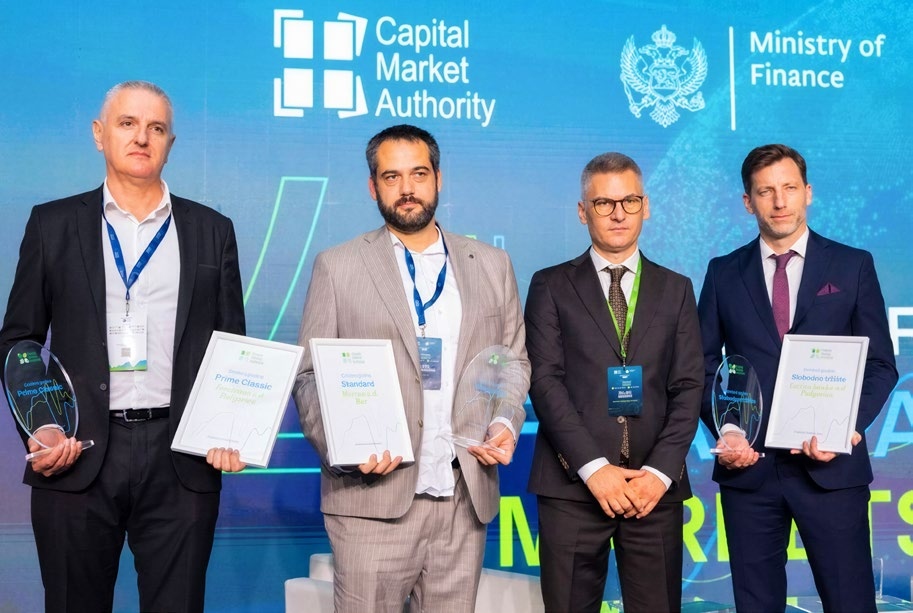
AWARDS FOR COMPANIES
During the first day of the conference, awards were also presented to companies that distinguished themselves in terms of transparency, accountability and the quality of corporate governance.
In the “Issuer of the Year – Prime Market Segment” category, the award was awarded to Zetatrans AD Podgorica, while Marina Bar AD received the award in the “Issuer of the Year – Standard Market Segment” category. Lovćen banka AD Podgorica was presented with the award in the “Issuer of the Year – Free Market” category.

CRD VI INTRODUCES NEW REQUIREMENTS
The next part of the conference featured a masterclass focusing on the European CRD VI Directive, which introduces changes in the area of capital. Strategic adviser and visiting professor Roger Hartman said that this year’s masterclass had been conceived as a new conference format, focusing on topics of importance to all participants in Montenegro’s financial system.
“The CRD VI Directive, adopted in 2024, is now moving into a key phase of implementation in Europe. If Montenegro achieves its ambition of becoming an EU Member State in 2028, this Directive will be a very important issue for everyone here today,” Hartman emphasised.
Samuel Grand, who joined online, highlighted new requirements for certain institutions and the strengthening of existing requirements, particularly in the area of planning and the continuous assessment of the suitability and competence of management.

CORPORATE GOVERNANCE
The results of the annual corporate governance report covering 40 issuers were presented by Ivana Bojanić, Head of the Department for the Supervision of Issuers, Stock Exchanges and the Central Securities Depository and Clearing Company (CKDD) at the Capital Market Authority. She recalled that corporate governance has been a relevant issue in Montenegro since the 1990s, while the first code was adopted in 2009. The new Corporate Governance Code was adopted in 2025, and its implementation began in January this year. According to data from this year’s report, the total turnover of all issuers at the end of last year amounted to just over EUR 83 million, while market capitalisation stood at approximately EUR 1.3 billion. The total share capital of the issuers amounted to EUR 2.2 billion.

TOKENISATION AS A NEW OPPORTUNITY
The second day of the conference concluded with a panel on tokenisation – the conversion of a particular real-world asset or financial instrument into a digital token that can be traded. Montenegro currently does not have the legal and technical framework that would enable the full implementation of tokenisation, but the panellists considered that this technology could represent a significant opportunity for development, particularly for markets that do not have sufficiently developed financial infrastructure. Lawyer Miroslav Đurić said that the European Union has been addressing the subject of tokenisation for years through measures in the field of digital finance.
According to Đurić, developing markets can, by implementing this technology at an early stage, bypass certain stages of development through which developed financial markets have passed. “Tokenisation is an emerging topic in the region. This is still a region where there is considerable potential for something like this. It is an opportunity for all countries in the region. Montenegro also has additional advantages, principally the fact that it uses the euro, as well as the process of accession to the European Union,” Đurić emphasised. Željko Drinčić, President of the Capital Market Authority, pointed out that tokenisation should not be regarded as equivalent to conventional digitalisation. He provided a bond as an example, where the record-keeping of ownership and the calculation of interest could be consolidated into a single system. “The objective of tokenisation is for it to be as inexpensive as possible. Tokenisation does not represent the asset itself, but rather the rules governing its transfer,” Drinčić said, pointing out that one of the key challenges is coordinating the transfer of rights with the movement of money.
According to Drinčić, Montenegro is currently not ready for the practical implementation of tokenisation, but this technology could support the development of the capital market and integrate the markets of countries in the region.
“Today, an investor seeking to purchase certain financial instruments in North Macedonia or Bosnia and Herzegovina has to engage a broker in that country and set up an account. Tokenisation could contribute to enabling the markets in the region to be viewed as a broader, integrated market,” Drinčić pointed out.
He identified lower costs and faster transactions as key drivers for the development of this technology, while pointing out that it is necessary to ensure that the new technology delivers tangible benefits to citizens, businesses and the state.
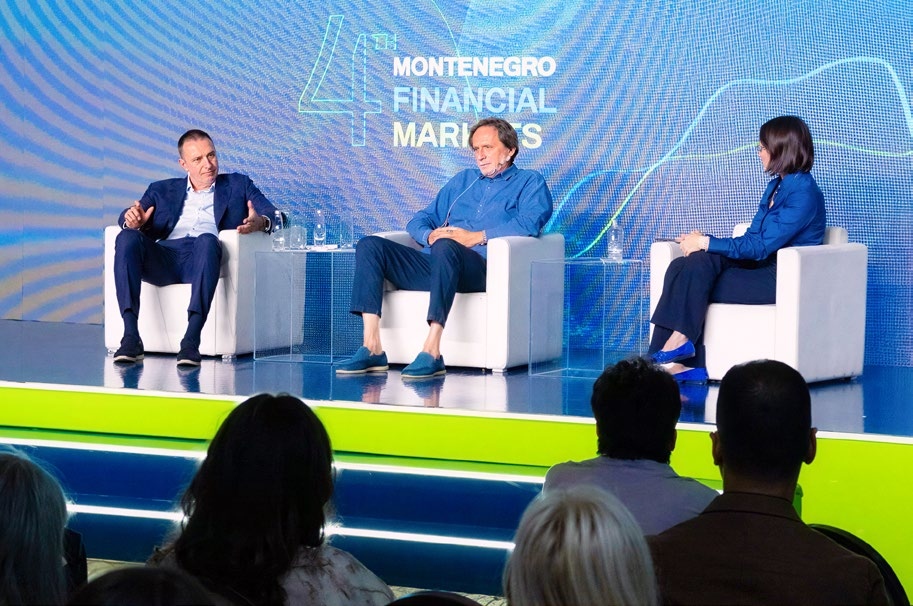
STRONGER LINKS WITH THE BUSINESS COMMUNITY
The President of the Capital Market Authority, which organised the conference in collaboration with the Ministry of Finance and with the support of the Bankar portal, said that one of the objectives of this year’s gathering was to forge stronger links between the capital market and the business community. Particular emphasis was placed on companies that are not yet present on the capital market and are exploring new forms of financing.
“We very much need the business community. These are companies that possess financial resources, that are developing and that need to identify their own way of obtaining financing through the capital market,” Drinčić said.
The conference thus brought to the fore issues of importance for the continued development of Montenegro’s financial system – from channelling citizens’ savings into investments and improving corporate governance to the application of novel technologies and forging stronger connections between the capital market and the business community.