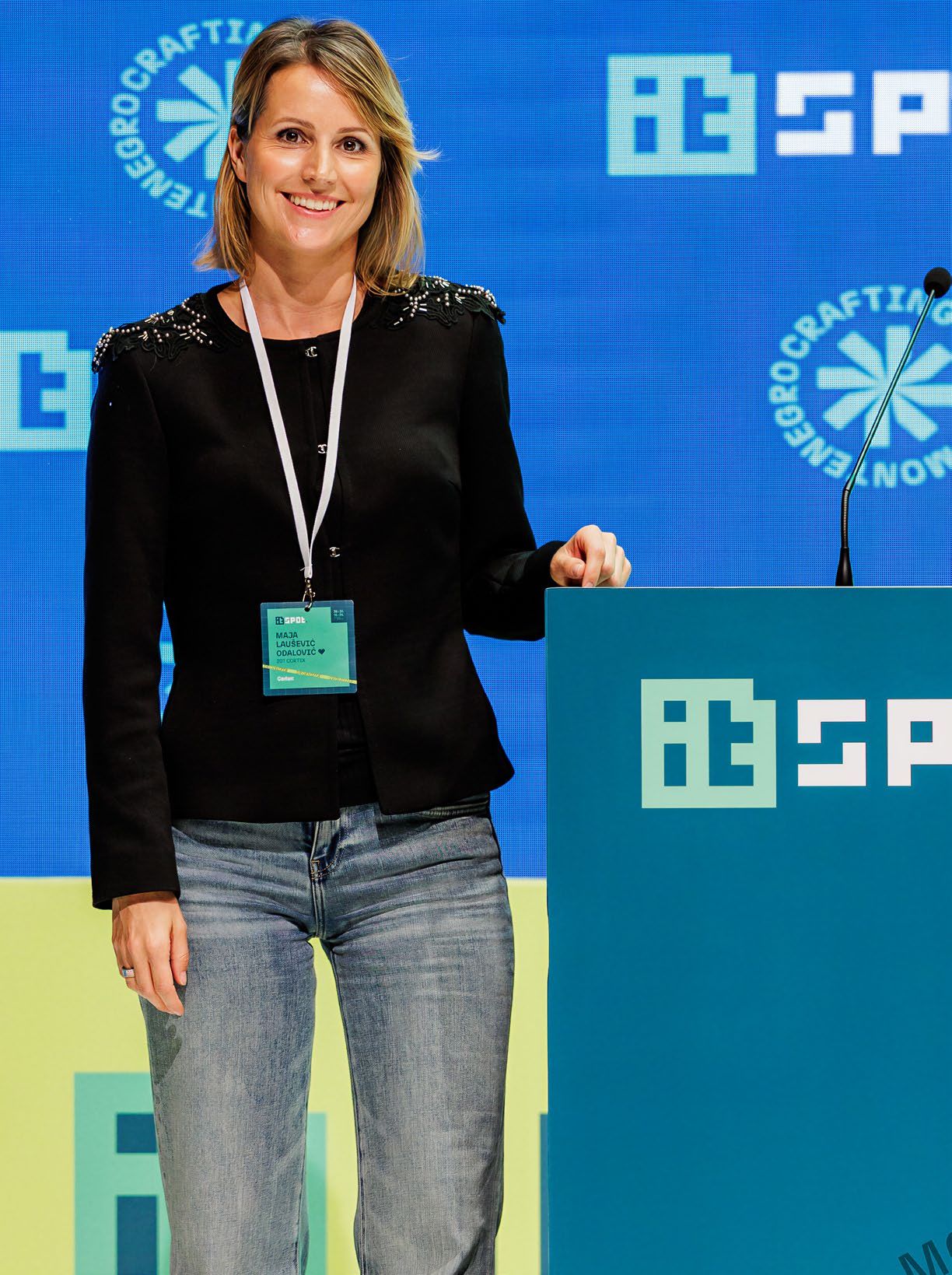
Maja Laušević Odalović, Executive Director of ICT Cortex
How Artificial Intelligence Can Propel the Country’s IT Sector Beyond Labour‐Based Exports, Turning Experience with Global Clients into Scalable Products, Intellectual Property and Technology for Regional and European Markets
Montenegro’s IT sector has made significant progress in recent years, building up experience through working with international clients and positioning itself as a reliable partner in the global market. However, the development of artificial intelligence is changing the rules of the game and prompting the question of what comes next for Montenegro’s technology industry. Rather than relying primarily on the export of services and human labour, AI is opening up opportunities for Montenegro to develop its own products, specialised solutions and intellectual property that can be introduced to regional and European markets. We spoke about where the greatest opportunities lie, what the domestic ecosystem is lacking and how AI can change the structure of Montenegro’s IT industry with Maja Laušević Odalović, Executive Director of ICT Cortex.
Until now, Montenegro has primarily exported IT services. With the AI revolution, can we make a significant leap forward and start exporting knowledge, products and our own technology?
Yes, and AI presents precisely the opportunity to make that leap. Montenegro has already built a solid foundation – we have companies operating internationally, experience in software development and an increasing number of domestic products and solutions. It is now important to build on this foundation and move from predominantly exporting services towards products, technologies and solutions with higher added value. AI can significantly accelerate this process, as it enables smaller companies to develop and test new solutions more quickly and compete in international markets with relatively small teams. The experience gained from working with international clients provides an important foundation for the next phase of development. The goal is to transform some of that knowledge, experience and those market contacts into our own IP, products and scalable solutions that can be exported.
Where do you see the greatest opportunity for Montenegro in the AI industry – in developing its own products, specialised AI solutions or positioning itself as a regional hub for the European market?
We see the greatest opportunity in a combination of the latter two models: specialised AI solutions and the development of products for specific industries, while positioning Montenegro as a small, agile technology hub for the European market. I do not think we should try to create a ‘Montenegrin OpenAI’. Our advantage does not lie in developing the most expensive foundation models, but in applying AI in areas where we already have expertise, a market or a comparative advantage. ICT is a horizontal technology that can increase productivity across almost all other sectors, which is one of the reasons why the Smart Specialisation Strategy recognises it as a driver of digital and innovation transformation. Montenegro also has comparative advantages as a market for development and testing, primarily due to the lower costs of developing and testing new business and technological concepts.
What are we currently lacking most in order to make that leap: capital, talent, education, infrastructure or government support?
I would not say that there is one key thing we are lacking. The biggest challenge is that we need to develop several links in that chain simultaneously. First and foremost, we need people. Not only AI engineers, but also people who understand how to turn technology into a product, a business and something that can be marketed internationally. We need researchers, engineers, product managers and entrepreneurs, as well as people who understand specific industries. The second is capital for innovation. We have companies that are already actively developing solutions, but the continuous development of a company’s own product is much riskier than working for an established client. We need instruments that will help companies make the journey from a prototype to a product with a viable market. We also need to be aware of a new challenge ahead – declining demand for junior-level professionals, as AI tools are already taking over some of the tasks that have traditionally served as an entry point into the IT industry. Finally, we need stronger links between government, academia and the business sector. Not merely through dialogue, but through concrete joint projects, research, pilot projects and commercialisation. That is why I would say we need an entire ecosystem.
Can a small economy like Montenegro compete in the global AI race and, if so, in which niches should we seek to build a competitive advantage?
It can, but not by trying to play the same game as the world’s largest economies. Our advantage cannot lie in the amount of capital available, the volume of data or the number of researchers. It can lie in speed, flexibility, specialisation and the ability to quickly connect technology with a specific market need. This could include specialised AI solutions for sectors in which we have domestic expertise and an established market base, such as tourism, finance, energy, public services and cybersecurity. Ultimately, the size of the domestic market does not have to be a limitation. If a product is developed from the outset with the aim of being applicable to the regional or European market, Montenegro can serve as a place for development, testing and scaling, rather than necessarily being the end market.
Does AI pose a threat to the traditional outsourcing model of Montenegro’s IT sector, or is it actually an opportunity for domestic companies to move towards higher-value-added products?
AI is both a challenge and a major opportunity. Some of the work that currently relies on repetitive programming, technical support or time-based billing will increasingly be automated. This means that the traditional outsourcing model will come under growing pressure, while clients will expect greater productivity and more value from the same level of engagement. However, this could be precisely the catalyst for the sector’s transformation. Montenegrin companies already have international clients, experience across different industries and a good understanding of their needs. Combining that experience with AI technologies creates opportunities to move from providing services towards developing their own products, platforms and specialised solutions. AI should therefore not be viewed solely as a threat to the existing model, but as an opportunity to take existing expertise to a higher level of value – moving from exporting labour and time towards exporting technology, knowledge and intellectual property.
What, specifically, should the government and the private sector do over the next five years to ensure that Montenegro truly becomes an exporter of AI knowledge and technology, rather than merely a user of solutions developed elsewhere?
First, investment in people and education – from modernising formal education to reskilling, upskilling and AI talent development programmes delivered through non-formal education. We need to develop people who not only use AI, but are also capable of developing it, applying it and turning it into products. At the same time, companies also need skills that are not purely technological – sales, product development, internationalisation, management and market expansion – because high-quality technology alone is not enough to become a successful export product. Second, we need to strengthen research, innovation and commercialisation. Companies developing their own solutions need support throughout the entire journey – from the idea, prototype and testing stages to securing the first customer and entering international markets. However, it is important that we do not focus solely on increasing investment, but also on monitoring the impact of that investment, so that we know which programmes and instruments deliver the best results and can redirect resources towards the areas where they can generate the greatest value. Third, the government can play a much more active role as a first customer and as a testing environment for domestic solutions. Public services offer considerable scope for the application of AI, while pilot projects in the public sector can provide domestic companies with references, product validation and the experience required to enter other markets.