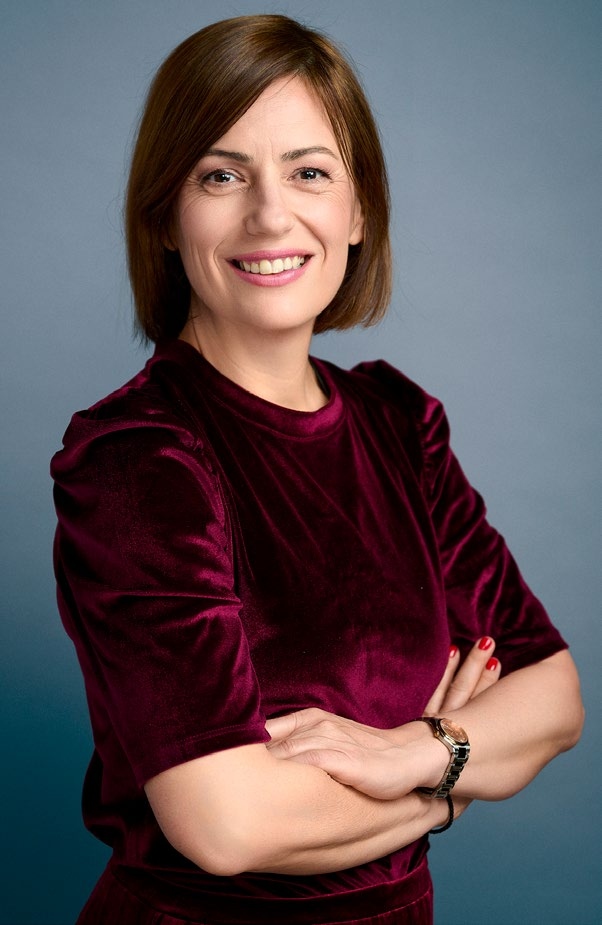
Aleksandra Božović, Managing Director of the Film Centre of Montenegro
From international awards to new investment and European co-productions, Montenegro is building its place on the regional and European film map
Film is far more than art. It is a tool of cultural diplomacy international visibility, and economic development. With Montenegrin cinema enjoying significant success abroad and a new legal framework opening the way for a stronger film industry, Montenegro has a chance to become a recognised destination for international productions and an equal partner on the European film scene. We spoke to Aleksandra Božović, Managing Director of the Film Centre of Montenegro, about new prospects, challenges and strategic priorities.
Can Montenegro become a recognised filming destination in the region and in Europe?
It can, and the process has already begun. Foreign producers were choosing Montenegro for its locations even before the Film Centre and the incentive scheme existed. What has changed in recent years is that Europe now also recognises films from Montenegro. This year, To Hold a Mountain (Planina) by Biljana Tutorov and Petar Glomazić won the World Cinema Grand Jury Prize: Documentary at Sundance, the greatest international success a Montenegrin film has achieved so far. The Herceg Novi Film Festival received FIAPF accreditation, the only newly accredited festival from the region, and Montenegro became the regional RE-ACT programme’s first guest partner. Recognition is built on two levels. The first is the conditions we offer foreign productions, and here the amendments to the Law on Cinematography were a major step forward. The second is a constant presence wherever decisions about films are made: Berlin, Cannes, Trieste, Rotterdam, Jihlava. A recognised destination is not a country someone discovers once. It is a country where industry people meet regularly and know how to work.
What are our greatest strengths, and where do we still lag behind the competition?
Our greatest strength is our locations and how close together they are. Within a small area, we have the sea, historic old towns, mountains, lakes and canyons, and a crew can move from one setting to another in a single day. For a production, that means fewer shooting days and lower costs. The second strength is the incentive scheme, which is now competitive: a 30 per cent rebate on costs incurred in Montenegro, an additional 5 per cent for filming in less developed municipalities, and filming permits issued by the Film Centre within 15 days. We see room to improve in everything that comes after the location. Montenegro has no film studio, and the supply of equipment and post-production services is still developing, so domestic productions source some of those services through regional partners, which is natural for a small film industry like ours. That is why it matters that the support system stays competitive and that we keep track of what the countries we compete with for the same projects are offering. The amendments to the Law on Cinematography showed that Montenegro can respond quickly, and the next step is measures to encourage investment in equipment and infrastructure.
How much can film contribute to Montenegro’s international image and its cultural diplomacy?
Film is one of the few ways a small country can win the attention of audiences who know almost nothing about it. When a Montenegrin film is selected for a major festival, the international film press writes about Montenegro in a context unrelated to tourism or politics. This year is a good example. To mark 20 years since the restoration of independence, we presented Montenegrin cinema in Cannes, and Montenegrin films were shown in special programmes in Ljubljana, Yerevan and at the Cinehill festival in Croatia. At the end of October, Montenegro is the focus country of the industry programme at the 30th anniversary edition of the Ji—hlava International Documentary Film Festival in the Czech Republic. In December, Podgorica will host a meeting of the Eurimages Board of Management, attended by representatives of national film funds from across Europe. During Montenegro’s Chairmanship of the Council of Europe’s Committee of Ministers, we are preparing a programme of Montenegrin film in Strasbourg. Still, cultural diplomacy only makes sense when good films back it up. We can organise programmes, but we are remembered for the films that meant something to audiences.
Do we want Montenegro to be just an attractive location for foreign productions, or also a country with a strong film industry of its own?
I don’t see that as a choice. Foreign productions and domestic cinema feed each other. The rebate applies to costs incurred in Montenegro, so foreign productions have an interest in hiring our companies, film workers and suppliers. On those shoots, our people learn, build credits, and make contacts, and later bring that experience to domestic films. A country that is only a location depends on other people’s decisions. If the competition offers more, the production goes elsewhere. A national cinema is what remains: the filmmakers, the films, the audience. That is why the Film Centre invests primarily in domestic production. Last year we supported 38 projects across ten categories, totalling €1.36 million, from screenplay development to feature films and minority co-productions. The results are visible: Nikola Vukčević’s The Tower of Strength (Obraz) has been seen by more than 23,000 cinemagoers in Montenegro, and To Hold a Mountain brought home an award from Sundance.
How developed is the domestic film infrastructure, and do we have enough skilled crew for major international projects?
Infrastructure is our weakest point, and we don’t hide it. We have no film studio. Part of the technical capacity is provided by RTCG and the Faculty of Dramatic Arts, and producers often look for equipment and post-production in the region. The crew exists, but there isn’t enough for several large projects at the same time, especially in specialised roles such as production design, special effects, make-up, costume, and post-production. The problem is circular: people gain experience only if there are enough projects, and projects go where experienced people are. That is why we invest in training. Through the RE-ACT programme, our professionals gain access to training and a co-development funding scheme; through the Creative Europe MEDIA Desk we steer them towards European programmes; and at Montenegro Film Rendezvous in Herceg Novi we organise workshops and meetings with European producers and funds. We also work with the youngest: together with the Bureau for Education Services, we have prepared Film Culture, a subject curriculum for primary schools.
Can the film industry become a serious part of Montenegro’s creative economy?
It can, and the figures already show it. An analysis by the Film Centre found that every euro paid out through the cash rebate generated around four euros for the Montenegrin economy, while €1.14 came back to the state budget through taxes and contributions. Money from a shoot does not stay in the film sector. Hotels, restaurants, transport companies, car rental firms, craftspeople and shops all work for the film crew throughout the weeks of shooting. Film is part of a wider creative economy that includes series, animation, video games, advertising and post-production. These activities employ young, educated people who can work for foreign markets from Montenegro. Under the amended law, VOD service providers must now also contribute to the Film Fund, which matters because audiences are increasingly moving to streaming. For film to become a serious branch of the economy, measures beyond film policy are needed too: tax incentives for investment in equipment and infrastructure, and a predictable tax policy.
How important are regional co-productions for a small film industry like Montenegro’s?
For a small film industry, co-production is a condition of survival. The Montenegrin market is small, and no feature film can be financed solely from domestic sources. Co-production brings money, but also partners, equipment, crew and audiences in other countries. The region is our natural partner because we share a language, an audience and experience, and films made through regional cooperation are watched in all our countries. The Tower of Strength, for example, was the first Montenegrin film to be released in cinemas in Slovenia. Every year, the Film Centre also supports minority co-productions; last year, it supported seven projects with €250,000, because even when we are not the majority partner, our people work on the film and the film carries Montenegro’s name. Regional cooperation alone is not enough, though. Membership of Eurimages, the film co-production agreement with France signed in Cannes last year, and our partnership in the RE-ACT programme open the door to European funds and partners. We created Montenegro Film Rendezvous precisely so that Montenegrin producers can meet them at home. Last year, more than 70 per cent of our international guests started talks on co-productions and partnerships.
What are the Film Centre’s key priorities for the next few years?
First, implementing the amended Law on Cinematography. The amendments were adopted in July, and now the focus is on making the new rules work in practice: higher incentives, filming permits within 15 days, and a single point of contact for producers in every municipality. The second is the new Cinematography Development Plan for 2027 to 2031. The public call for participation in drafting it is open until 15 October, and we invite film professionals, associations and local governments to take part. That document will determine what we fund, and how, over the next five years. The third is continuity in our support for domestic production, from screenplay development to distribution, with particular attention to women and young filmmakers. The fourth is audiences. The cinema exhibitors’ network we set up two years ago, together with the digitisation of screening rooms in cultural centres, has brought film back to towns that had had no cinema for years. Sold-out screenings of The Tower of Strength in Berane, Pljevlja, Bijelo Polje and Nikšić showed that the audience is there when films are brought closer to it. The fifth is international promotion through festivals, markets, and Montenegro Film Rendezvous, which we want to make a fixture of the regional film calendar. A studio would be a major step forward, but only if it had work. A studio that stands empty for most of the year is not a success but a burden. Countries with successful studios, such as Hungary or the Czech Republic, have them because they have a steady flow of large productions, experienced crews and a stable incentive system. The natural route is private investment, supported by tax incentives the state can offer. That is also one of our recommendations from the analysis of the film industry’s economic impact. The Film Centre’s role is to create the conditions for such investment to pay off: a competitive incentive, efficient procedures, and enough qualified people. Until then, it is more realistic to develop the smaller capacities we lack today, such as rental equipment and post-production.
When we talk about a ‘new film map’, where do you see Montenegro on that map in five years?
I see a country where several major foreign productions shoot every year, and not only on the coast but in the north too. I see domestic production companies that have gained experience on those projects and are equal partners in European co-productions. I expect Montenegrin films to be in the programmes of major festivals regularly, not occasionally, and a generation of filmmakers who have already been through European development programmes with their first films. With its FIAPF-accredited festival and Montenegro Film Rendezvous, Herceg Novi can become the place where the regional industry meets every August. That map depends not only on the Film Centre, but also on filmmakers, producers, municipalities, the Government, and investors. Our job is to build a system that keeps working when the people running it today have moved on. If, in five years, foreign producers are coming to Montenegro for the second and third time, we will know we have succeeded.