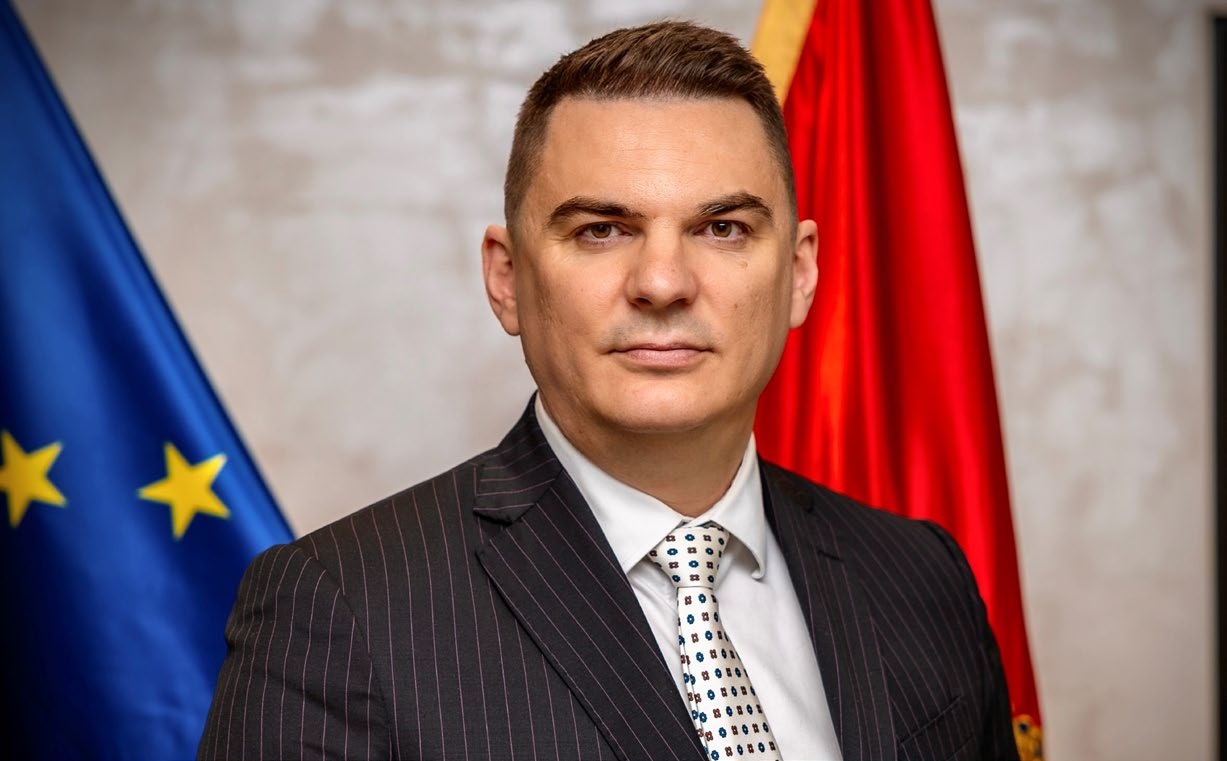
Admir Šahmanović, Minister of Energy and Mining
From potential to investment: can sun, wind and water turn a small country into a regional energy hub?
Montenegro is entering a phase in which energy policy is no longer only a question of supply security, but also of development, investment, and the country’s new economic position. Sun, wind, and water, together with a strategic position relative to the European market, give the country potential that reaches beyond the traditional energy sector. But potential alone is not enough. It takes a stronger grid, energy storage, a stable regulatory framework, international capital and projects that will turn renewable energy into new industrial and investment value. Talking about the next phase of Montenegro’s energy sector, the minister raises a question that could define the country’s economic position for decades to come: can Montenegro become a place where energy is not only produced, but also stored, traded and used to develop new industries?
Can Montenegro turn its renewable energy potential, in sun, wind and water, into a strategic economic and investment advantage and position itself as a regional energy hub?
It can. And I think the question is no longer whether we have the potential, but whether we will turn it into concrete projects quickly enough. Montenegro has what Europe will need more and more in the coming decades: clean energy, room for new capacity and a strategic position between the region and the European Union market. But nature alone is not an investment strategy. We need projects, a grid, storage, a well-regulated market and a stable regulatory framework. That is exactly what we have been working on: putting the system in order and aligning it with European rules. We have passed key laws, completed important steps in integrating the electricity market, adopted the National Energy and Climate Plan and created a regulatory framework that gives investors greater certainty. At the same time, we have decisively opened Montenegro to international partners. Today we are in talks and working with companies and institutions from Italy, France, the United States, Japan and the United Arab Emirates, as well as other European countries. These partnerships are not just diplomatic contacts. They must bring capital, technology, know-how, and concrete projects. With Italy, we are developing energy cooperation and working to further strengthen the links between our markets. With France, we have opened the way to cooperation on developing the electricity grid and hydropower potential, and on the energy transition. With the United States, we are discussing projects that could be important for Montenegro’s longterm energy and economic security, including developing new energy capacity and infrastructure. Japan is an important partner for technology, energy efficiency, and modernising the system. The partnership with the UAE and Masdar also opens the door to large renewable projects and a new scale of investment. That shows one important thing: Montenegro is no longer merely an observer of the energy transition. It is becoming a place international partners come to discuss projects. So we have put the system in order and aligned it with European rules. Now we are entering a phase in which that foundation has to be turned into investment and a new generation. The ultimate goal is not simply to produce more electricity. We want Montenegro to be a place where energy is produced, stored, traded and used to develop new industries.
What are the most important energy projects at the moment, and how much new generating capacity do you expect over the next five to ten years?
We already have an investment cycle that Montenegro has not had in a long time. We are working on new solar and wind capacity, the development and construction of the Gvozd 2 wind farm, the projects at Štedim and Kapino Polje, the modernisation of hydropower capacity, and large energy storage projects. Cooperation with international partners is particularly important. The partnership with Masdar opens the door to developing a large portfolio of solar projects, with the ambition of building capacity in the coming years measured in gigawatts rather than tens of megawatts. That is a change of scale. If we look ahead five to ten years, we are talking about the potential for several gigawatts of new renewable capacity. Still, I do not want to reduce Montenegro’s energy future to a single figure. What matters more is that this capacity is connected to the grid, storage, and the market. Because a megawatt on paper is not the same as a megawatt that can be reliably delivered to the market.
What needs to improve in Montenegro’s electricity grid and infrastructure to absorb a larger share of renewable energy and increase electricity exports?
If we want more solar and wind farms, we need a stronger grid at the same time. That is one of the most important things people often miss when we talk about the energy transition. That is why, alongside new generating capacity, we are investing in transmission and distribution infrastructure: substations, power lines, grid transformation, and cross-border interconnections. The second cable to Italy is an important part of that story. By doubling the capacity of the link with the European market, Montenegro gains more scope to sell surplus energy, and also to import it when that makes economic sense. In addition, the memorandum of understanding on electricity market coupling between Italy and Montenegro is a turning point and a key step that already makes Montenegro part of the EU, at least in energy. Here, our geography becomes an advantage. We can generate when we have sun and wind, use hydropower as a key balancer, store energy, and connect to a large European market. That is the basis of an energy hub, not just of an electricity producer.
How important will new technologies, battery storage, smart grids and artificial intelligence be for the future of Montenegro’s energy sector?
They will be decisive. The energy system of the future will not be one with a few large power plants and a grid that carries energy from producer to consumer. It will be a far more dynamic system, with solar plants, wind farms, batteries, hydro storage, active consumers, electric vehicles and digital management. Battery storage is particularly important because it lets us use energy produced when there is most of it at the times we need it most. Artificial intelligence will increasingly help us forecast generation and consumption, manage the grid, and make better use of existing infrastructure. We do not see the energy transition only as a shift from fossil fuels to renewables. It is also a digital transformation of the energy system.
Can the energy transition become a new driver of Montenegro’s economy, by attracting investment, developing new industries and creating quality jobs?
Not only can it; I think it has to. Montenegro must not remain merely a place where electricity is produced and exported. If we have enough clean, competitive energy, we can attract other investment as well: industry, technology companies, data centres, equipment manufacturing, and a whole chain of new services. For an investor today, it is not only the price of land or the tax system that matters. What matters more and more is whether they can secure clean, reliable energy available over the long term. That is where Montenegro has its chance. The energy transition can create new quality jobs for engineers, technicians, IT specialists, operators and a whole range of new professions. That is why we have to see energy not only as a commodity, but as infrastructure for the development of the entire economy.
What next project or government move could prove decisive for the ambition of making Montenegro a regional energy hub?
I would not say that a single project will solve everything. The decisive moment will come when we connect what we are already building: new sources, a stronger grid, storage and access to the European market. If I had to single out one direction, I would say large integrated renewable energy projects linked to storage and the grid. That is the next level. Because our task should not be to have as many power plants as possible. We need an energy system that is strong, flexible and connected enough for us to produce, store, use and export energy when it is most needed. Montenegro is a small country. But in energy, size is not the only advantage. We have sun, wind, water, the sea, the European market on our doorstep, and energy infrastructure already in place.
If we combine that with capital, technology and good governance, we can build something much bigger than the energy sector itself. We can build a new economic position for Montenegro, as a country that connects the region with Europe through energy. And I think that now is exactly the moment to turn that opportunity into projects.